
All notes
AUTOMATION / ADEPTA NOTE 03
What software should do itself — and what a person must approve
Good automation removes repeated work without turning the business into a black box that acts faster than anyone can understand. 10 min read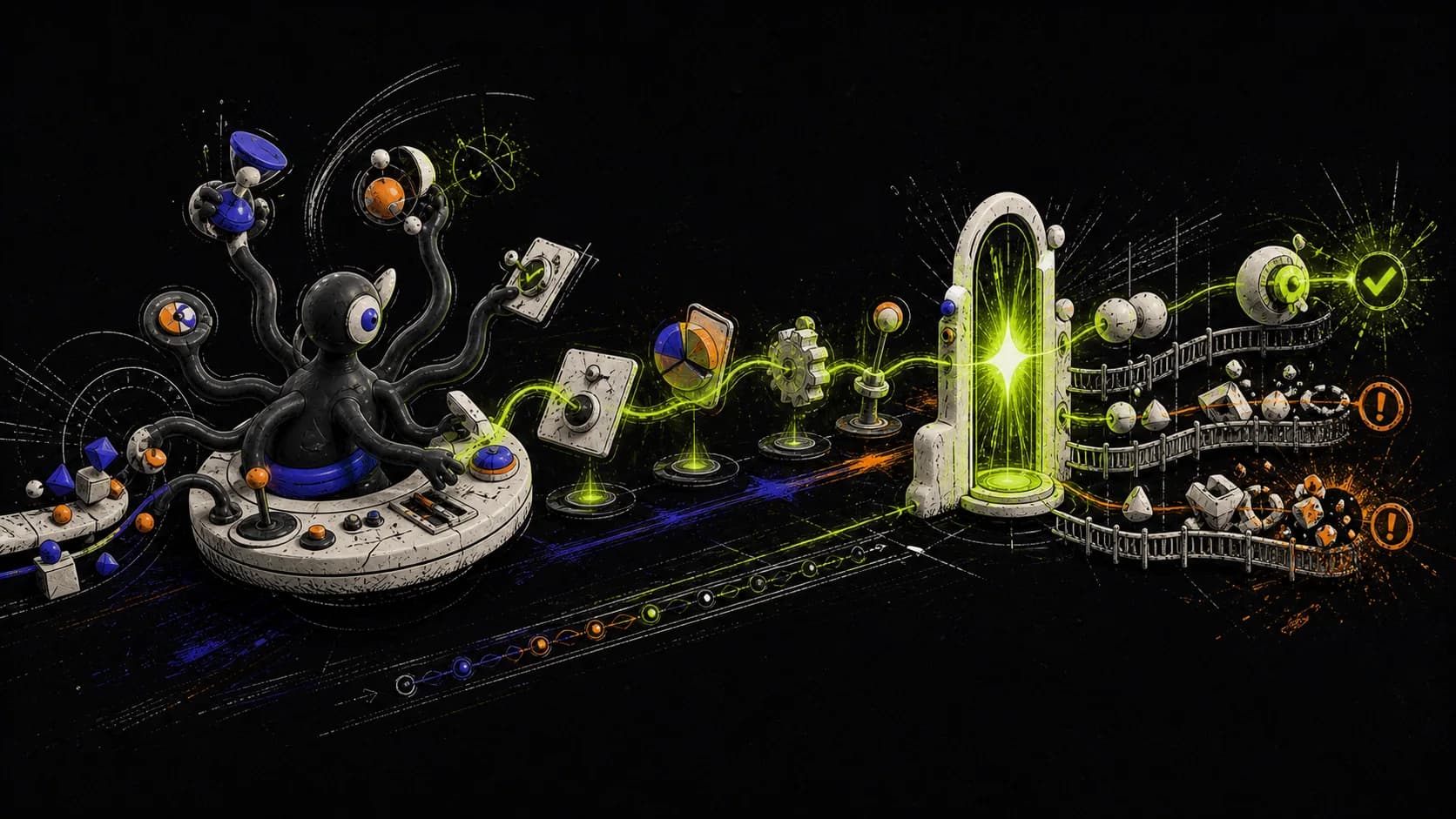
Automate observation first, preparation second and action only when the risk is bounded.
The first automation should explain, not act
A system can already save hours by collecting spend, sales, stock, capacity and campaign changes into one readable brief. It can highlight an anomaly and prepare a recommendation while having no permission to change a budget or contact a customer. This observation layer creates value quickly and exposes weak data before automation can amplify it.
Automate repeated preparation next
Campaign drafts, document collection, report assembly, creative resizing, naming and task creation are structured, frequent and easy to review. Software can perform the mechanical work and present the result to a person. The team stops copying fields but keeps control over what reaches the outside world.
- Collect and normalize information
- Create drafts and previews
- Route the result to the right owner
Put approval where reversibility ends
Renaming a draft is easy to reverse. Sending thousands of messages, deleting customer data, changing a large budget or pausing every campaign is not. Human approval belongs at that boundary. The interface should state what will change, why, how many objects are affected and how to roll it back before the button is pressed.
Use hard guardrails, not polite instructions
A prompt saying “be careful” is not a control system. Limits must exist in code and permissions: maximum spend change, allowed accounts, approved countries, working hours, data fields and action frequency. If an action falls outside the boundary, the system stops and asks rather than improvising.
Make every action reconstructable
A useful log stores the source data, evaluated rule, proposed action, approver, API response and follow-up check. This is more than technical history: it lets the business answer who changed what, whether the change worked and how to improve the rule without guessing.
Do not automate a process nobody understands
If ownership is unclear, exceptions are constant and nobody can define a good outcome, automation will preserve confusion at higher speed. Map the process, remove unnecessary steps and measure the current baseline first. Sometimes the best automation is deleting the task entirely.
ADEPTA / WORKING NOTE